
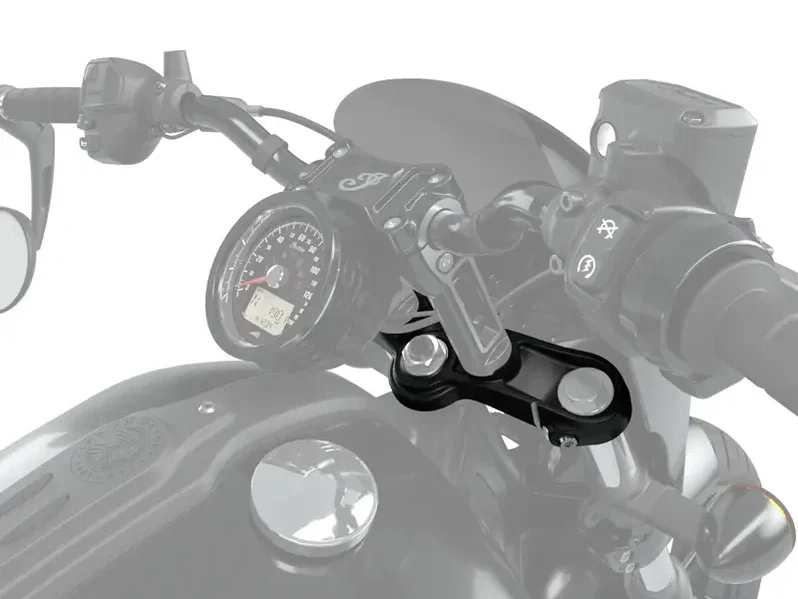
Advantages of forging triple clamp for High-Performance Motorcycle Engineering
The Ultimate Professional Guide to forging triple clamp Manufacturing
Understanding the Function of a Triple Clamp
Role in Motorcycle Steering Geometry
The triple clamp directly influences:
- Rake angle
- Trail measurement
- Fork alignment
- Suspension behavior
Any flex or misalignment affects cornering precision and tire contact consistency.
Load Distribution and Structural Integrity
Under braking forces and road impacts, extreme loads pass through the clamps. Forged components provide optimized grain flow, distributing stress evenly and preventing localized weaknesses.
Why Forging is Superior to CNC Billet and Casting
When comparing manufacturing techniques, forging stands out due to material science advantages.
Grain Flow Alignment Advantages
In forging, metal grains flow along the shape of the part. This alignment increases strength in high-stress areas. Unlike casting, which may introduce porosity, forging compresses the material, reducing internal defects.
Fatigue Resistance and Impact Strength
Forged parts exhibit:
- Higher fatigue life
- Improved impact resistance
- Greater structural reliability
For racing applications, these benefits are non-negotiable.

Materials Used in forging triple clamp Production
Material selection determines weight, rigidity, and cost.
6061-T6 Aluminum
- Good corrosion resistance
- Moderate strength
- Cost-effective for street applications
7075-T6 Aerospace Aluminum
- Exceptional strength-to-weight ratio
- Higher fatigue resistance
- Superior stiffness
Step-by-Step Forging Manufacturing Process
Billet Preparation
Raw aluminum billets are cut and heated to optimal forging temperatures (typically 400–480°C for aluminum alloys).
Die Design and Engineering
Precision dies are created using CAD modeling. These dies control:
- Grain flow direction
- Final geometry
- Stress concentration zones
Closed-Die Forging Operation
In closed-die forging, heated material is pressed between shaped dies under extreme pressure. This compression refines the internal structure and eliminates voids.
Heat Treatment and Finishing
Post-forging treatments include:
- Solution heat treatment
- Artificial aging
- CNC precision machining
- Surface finishing
Mechanical Properties and Performance Metrics
Tensile Strength
7075-T6 forged components can exceed 500 MPa tensile strength.
Yield Strength
High yield strength ensures the clamp maintains shape under braking forces.
Fatigue Life
Forged aluminum significantly outperforms cast alternatives in cyclic stress environments.
Tolerances and Precision Machining After Forging
While forging shapes the part, CNC machining ensures:
- ±0.01 mm dimensional accuracy
- Perfect fork tube fitment
- Steering stem alignment
Precision here ensures smooth steering and vibration reduction.
Surface Treatment and Corrosion Protection
Anodizing
Anodizing improves corrosion resistance and allows custom finishes, often seen in premium motorcycles from KTM AG.
Hard Coating
Hard anodizing enhances wear resistance, especially around fork pinch bolts and steering stem bearings.
Quality Control and Testing Standards
Professional manufacturing facilities conduct:
- Ultrasonic testing
- X-ray inspection
- Hardness verification
- Dimensional CMM scanning
For international quality standards, refer to ISO guidelines at https://www.iso.org.
Cost Analysis and Production Scalability
While tooling costs for forging are higher initially, per-unit cost decreases significantly in volume production. For OEM manufacturers, forging becomes economically viable at scale.
Small-batch racing components may use hybrid approaches: forged blank + CNC finishing.
Common Engineering Challenges
- Die wear management
- Maintaining grain flow consistency
- Controlling heat treatment distortion
- Minimizing machining waste
Experienced engineers mitigate these issues through simulation software and finite element analysis.
Conclusion
For professionals in motorcycle engineering, the forging triple clamp represents the pinnacle of structural integrity and performance optimization. Through advanced material science, grain alignment, and precision finishing, forged clamps deliver superior durability, fatigue resistance, and handling precision.
As racing demands increase and engineering tolerances tighten, forging continues to outperform alternative manufacturing methods. Whether in OEM production or elite motorsports, investing in forged components ensures long-term reliability and uncompromising performance.
Frequently Asked Questions
1. Why choose forging over billet machining?
Forging aligns grain flow, increasing strength and fatigue resistance compared to billet machining.
2. What alloy is best for professional racing clamps?
7075-T6 aluminum is widely preferred due to its high strength-to-weight ratio.
3. How does forging improve durability?
Compression during forging eliminates internal voids and refines grain structure.
4. Is forging triple clamp suitable for street motorcycles?
Yes, though often more beneficial in performance or racing applications.
5. What tolerances are achievable after machining?
High-end manufacturers achieve ±0.01 mm precision.
6. Does forging reduce weight?
Forging allows optimized structural geometry, reducing material without sacrificing strength.
 Facebook
 LinkedIn
 X
X
 WhatsApp
 Email
Email